- +49 (0)761 8879 4575
- Drop us a line!
- Real expert advice
- 36 rolls with logo from €139*
- Pay by invoice
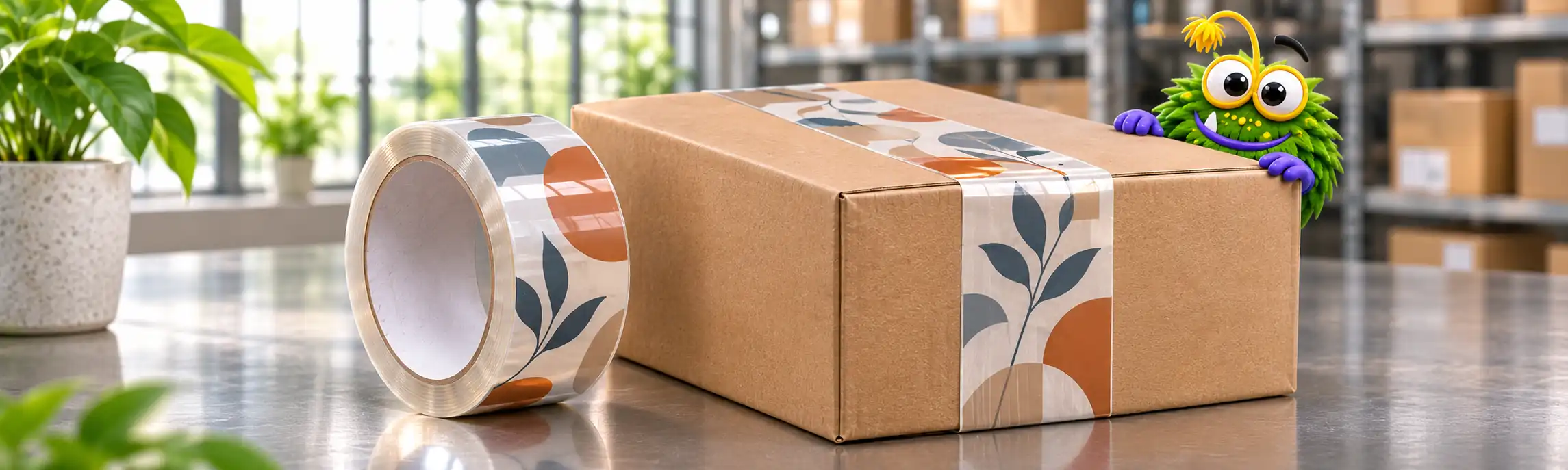
Hot melt packing tape is a packing tape made of polypropylene (PP) film that is coated with a hot-applied hot melt adhesive based on synthetic rubber. It bonds instantly when pressed down, needs no drying or curing time, and is the best-selling tape for carton sealing in shipping. In this guide, you'll learn how hot melt packing tape is constructed, how it's made and when it's the right choice – and when you're better off reaching for a different tape.
All technical values in this article come from the current data sheets of our PP packing tapes (as of 08/2026). Wherever we quote general guideline values from packaging practice, we say so explicitly – so you never confuse data sheet values with rules of thumb.
Hot melt packing tape (also called hot-melt tape, hotmelt packing tape or PP packing tape with hot melt adhesive) is a self-adhesive packaging tape for sealing cartons. The term, however, doesn't describe the film – it describes the adhesive: a hot melt is a hot melt adhesive that is applied to the backing film hot and liquid during manufacturing and solidifies into a permanently tacky layer as it cools – entirely without solvents or water.
The crucial difference from hot glue out of a glue gun is that the hot melt on packing tape stays pressure-sensitive after cooling. Experts call this a pressure sensitive adhesive, or PSA for short. So the tape never needs to be heated – it only needs to be pressed down. Under light pressure, the adhesive flows into the pores and fibers of the carton surface and anchors itself there within seconds.
The backing material is a PP film made of polypropylene. During manufacturing it is stretched lengthwise and crosswise, which makes it extremely tear-resistant and at the same time stretchable at a thickness of just 25 µm. The combination of PP film and hot melt adhesive has been the standard for packing tape in mail-order shipping for decades, because it unites three properties that usually contradict each other: high adhesive strength, high processing speed and a low price.
On the market, you'll find the spellings hotmelt, hot-melt and hot melt side by side. They all mean the same product. At Tapemonster it's available as PP packing tape with logo (standard, loud unwind) and as a reinforced, quiet-unwind version under the name Super-Melt packing tape.
Hot melt doesn't stick because it "dries" – it sticks because it flows. The adhesive layer behaves like a very viscous liquid: firm enough to stay on the roll, yet soft enough to conform to every bump and dip under pressure. Three things happen in quick succession:
Your thumb, the pressure roller on the dispenser or the roller of the case sealer presses the tape onto the carton.
The adhesive flows into the rough, fibrous surface of the carton. The better this wetting, the larger the contact area.
Adhesive forces between adhesive and carton plus mechanical interlocking in the fibers hold the seal. Full ultimate adhesion is reached after a few minutes.
The second half of the equation is cohesion – the internal strength of the adhesive layer. It ensures that the tape doesn't "flow apart" under tension and that the adhesive doesn't stay behind as a smeary film on the carton when the tape is pulled off. A good hot melt formulation balances tack (initial tackiness), adhesion and cohesion so that the tape grabs instantly yet still holds up under load.
Press it down, done. There's no waiting time during which the carton has to sit still. That's why hot melt is the standard tape for packing lines and conveyor belts, where every carton goes straight on to shipping.
The rubber adhesive wets out rough, fibrous and slightly dusty surfaces better than water-based acrylic adhesives. On corrugated cardboard with a high recycled content, that's the decisive advantage.
According to the data sheet, the PP film reaches an elongation at break of 160 %. When a package takes a knock in transit, the tape gives instead of tearing – the carton stays shut.
Hand dispensers, tabletop dispensers, semi- and fully automatic case sealers: hot melt packing tape unwinds evenly and tolerates high processing speeds. Standard core 76 mm (3"), standard widths 48 mm (1.9") and 50 mm.
Hot melt is processed as 100 % solids – no VOC emissions, no solvent smell while packing. According to the data sheet, the tape contains no hazardous or harmful substances and complies with REACH Regulation (EC) No. 1907/2006.
Among packing tapes, hot melt offers the best value for money. The smooth, corona-treated PP film takes flexo printing ink cleanly – ideal for packing tape with your logo.
Hot melt packing tape consists of just three layers, together thinner than a human hair. Yet every layer carries a piece of materials engineering that decides whether your carton stays shut or not.
Layer structure of PP Hot-Melt (cross-section, not to scale)
The backing film is made of polypropylene (PP) and is stretched lengthwise and crosswise during manufacturing (biaxially oriented). This aligns the polymer chains and makes the film exceptionally tear-resistant, dimensionally stable and clear at a very low thickness. Our standard film is just 25 µm thin – a human hair, by comparison, measures around 60 to 80 µm.
The film comes in the base colors clear, white and brown. Clear film shows the carton and any print underneath, white film is the neutral print surface with maximum contrast, and brown film blends in with corrugated cardboard. Before coating, the film is corona-treated: an electrical discharge raises the surface tension so that adhesive and printing inks bond reliably.
Film thickness also affects unwind behavior. A slightly thicker, stiffer film dampens the noise made when the adhesive separates from the roll. That's why our quiet-unwind Super-Melt packing tape uses a 28 µm film for a total thickness of 50 µm.
The adhesive is a hot melt formulation – a blend of four groups of components that the adhesive manufacturer tunes to one another. Roughly speaking, about half of it is resin, a third is polymers, and the rest is oils and additives. The exact formulation is every manufacturer's trade secret. On our standard tape, 17 g/m² of it ends up on the film (tolerance: 16 to 18 g/m²), which corresponds to a layer thickness of around 20 µm.
Styrene block copolymers (SIS/SBS) form the backbone. They provide cohesion – internal strength – and the elasticity that lets the tape absorb impacts.
Tackifying resins turn the rubber into a pressure-sensitive adhesive: they create the tack (initial tackiness) and ensure that the adhesive wets out the carton surface.
Plasticizing oils and waxes set the melt viscosity so that the adhesive can be coated evenly at 150 to 180 °C, and fine-tune the softness of the finished layer.
Stabilizers protect the rubber from aging caused by heat and atmospheric oxygen – on the roll in the warehouse just as much as in the melter during production.
These values come from the technical data sheet "PP Hot-Melt / loud unwind", Rev. 08/2026. They are average values from random samples of ongoing production – in other words, what you can realistically expect, not guaranteed minimum values.
| Property | Typical value | Tolerance | What the value means for you |
|---|---|---|---|
| Backing material | PP | – | Biaxially oriented polypropylene film, corona-treated, printable |
| Backing film thickness | 25 µm | ± 3 % | Thin and tear-resistant; Super-Melt (quiet unwind): 28 µm |
| Total thickness | 45 µm | ± 5 % | Film + adhesive; Super-Melt: 50 µm |
| Adhesive type | Hot melt | – | Synthetic rubber, solvent-free, pressure-sensitive |
| Coat weight | 17 g/m² | 16 – 18 g/m² | Higher coat weight = more adhesion on rough surfaces, but also a higher price |
| Peel adhesion to steel | 4.9 N/cm | ± 3 % | Peel strength in the 180° peel test (tested per ISO 29862) – the measure of ultimate adhesion |
| Elongation at break | 160 % | ± 3 % | How far the tape can be stretched before it tears (tested per ISO 29864) |
| Tack (rolling ball test) | 7 cm | ± 3 % | Initial tackiness: the shorter the distance the steel ball rolls, the "grabbier" the adhesive |
| Film colors | 3 colors | – | White, brown, clear – all printable, too |
| Standard roll | 48 mm × 66 m | – | 76 mm core – fits common hand, tabletop and machine dispensers |
| Unwind noise | loud | – | Quiet unwind: Super-Melt packing tape |
| Performance warranty | 6 months | from delivery | Warranty period per data sheet; with proper storage, adhesive strength lasts considerably longer in practice |
Source: Technical data sheet PP Hot-Melt, loud unwind, Rev. 08/2026 (Ref. 268). According to the data sheet, the product contains no hazardous or harmful substances and is REACH-compliant.
Application temperature: ideally +10 to +40 °C, not below +5 °C. Service temperature after sealing: about −20 to +60 °C; constant exposure above 50 to 60 °C weakens adhesion. Storage: 15 to 25 °C, below 65 % relative humidity, protected from light. These values apply to PP hot melt packing tape in general – if your application pushes up against one of these limits, get advice first or test with a sample.
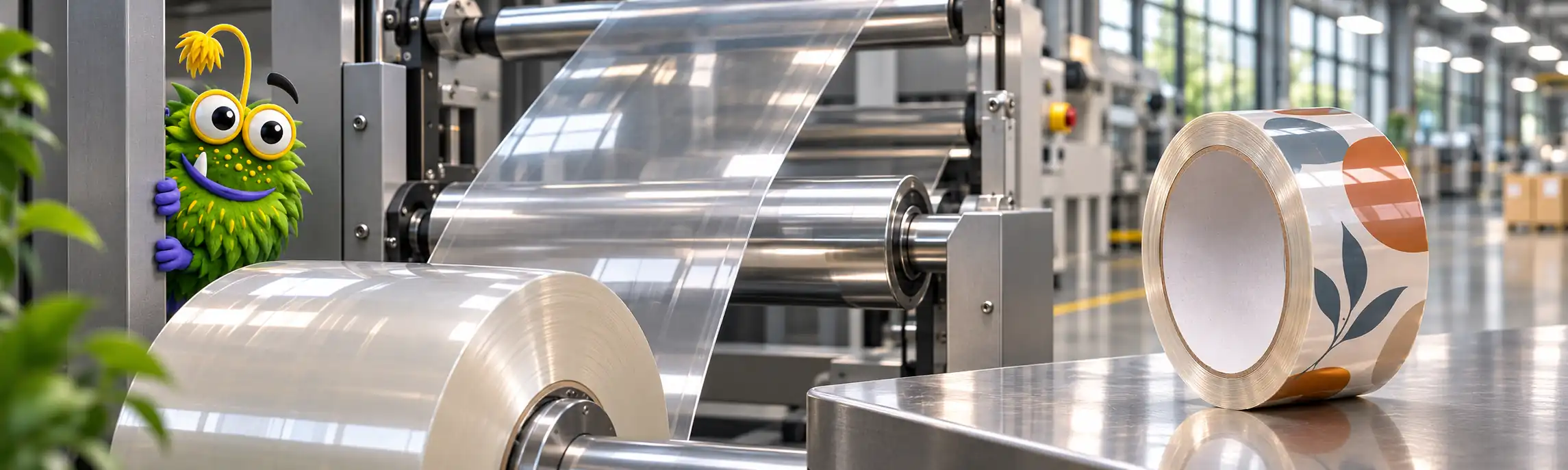
Production runs fully automatically on coating lines that process film webs several meters wide. The goal in every step: a coat weight that stays the same to the gram over thousands of meters – because that's exactly what determines whether every roll bonds like the one before it.
Polypropylene is extruded into a film and then stretched lengthwise and crosswise (biaxial orientation). The surface is then corona-treated so that adhesive and printing ink bond reliably later on. A wafer-thin release coating on the back ensures that the finished tape can be released from the roll.
25 µm film · corona-treatedRubber polymers, tackifier resins, oils and antioxidants are processed in a melter or extruder at around 150 to 180 °C into a homogeneous, solvent-free adhesive mass and filtered before coating. There's no solvent that has to evaporate and no water that has to dry.
150–180 °C · 100 % solidsThe liquid adhesive is applied evenly to the moving film web through a slot die or a roll coater. Coat weight is the most important control variable: our standard tape receives 17 g/m² (tolerance 16 to 18 g/m²). More adhesive means more adhesion on rough surfaces, but also higher costs.
17 g/m² ± 1 g/m²The coated web runs over chill rolls. Within seconds, the hot melt solidifies into a ready-to-grab, permanently pressure-sensitive layer. Because no drying tunnel is needed, this step uses considerably less energy than manufacturing water-based acrylic tapes.
Seconds instead of a drying tunnelThe finished web is wound into a jumbo roll several thousand meters long. Slitting machines then cut it into the sales widths – usually 48 or 50 mm – and wind it onto 76 mm cores with a length of 66 m (50 or 100 m are also common).
48/50 mm × 66 m · 76 mm coreRandom samples from ongoing production are tested for peel adhesion to steel, rolling ball tack, elongation at break and thickness. Every delivery carries a batch code on the roll label or delivery note – since the EU Packaging Regulation PPWR, this traceability is mandatory, not optional.
ISO 29862 · ISO 29864 · rolling ball testFor printed packing tape, the design is flexo-printed onto the film – depending on the production line, either before coating or onto the finished jumbo roll. The flexo printing plate (cliché) is made once and kept on file for reorders. We explain exactly how the printing works in our article on flexo printing.
Flexo printing · 1–3 colors · from 36 rollsA packing tape doesn't need the highest adhesion value in the world. It needs to bond on roll 1 exactly the way it bonds on roll 36 – otherwise you're constantly readjusting your dispenser or finding open cartons at your customer's door. That's why, when selecting our tapes, we look at the tolerances in the data sheet first and at the peak values only after that.
Wherever cartons need to be sealed quickly, reliably and in large numbers, hot melt is the first choice. Here are the typical fields of use – and what tips the scales in each of them.
The core business: sealing shipping cartons and corrugated packaging securely. Hot melt bonds instantly to recycled cardboard, handles high throughput at the packing station and is the cheapest sealing tape per meter. For online retailers and fulfillment providers, that makes it the standard – with or without a logo.
In logistics centers, packing tape runs through hand dispensers with a brake, tabletop dispensers and automatic case sealers. Hot melt packing tape unwinds evenly, can be adjusted to the machine tension and keeps cartons shut even when they're stacked, transshipped and bumped on roller conveyors over and over.
Outer packaging for components, bundling cables and profiles, fixing protective films, securing packing slips to the carton: hot melt provides a strong, flexible bond that shrugs off mechanical stress. For especially heavy packages or very rough surfaces, it's worth reaching for the reinforced Super-Melt packing tape.
Tool crates, spare parts cartons, deliveries to the job site: trade businesses use hot melt packing tape for sealing, for temporarily fixing films and insulation materials, and for bundling. Important for outdoors: standard hot melt is meant for dry, UV-protected applications – when it's exposed to wind and weather, reach for PVC tape.
Every sealed carton is an advertising space the recipient is guaranteed to look at. Printed hot melt packing tape with your logo turns a plain brown box into a branded package – without having to stock printed cartons. How the printing works is covered in Chapter 8.
A shop shipping 300 packages a day uses around 2.6 m of tape per carton with an H-seal (top and bottom). That's about 12 rolls of 66 m per day – so a starter pack of 36 rolls lasts for three shipping days. You'll find the math in the practical tips.
Hot melt is the all-rounder – but not the best solution for every case. This overview shows which tape comes out ahead for which requirement.
| Your situation | Recommendation | Why |
|---|---|---|
| Standard shipping cartons, medium-weight packages | PP Hot-Melt | Instant adhesion, good wetting on recycled cardboard, best value for money |
| Heavy cartons, rough recycled cardboard, high impact loads | PP Super-Melt | Thicker 28 µm film, 50 µm total thickness, reinforced hot melt adhesive |
| Packing station in the office, retail store, noise-sensitive environment | PP Super-Melt (quiet) or PVC | Quiet unwind – no ripping noise with every carton |
| Cold storage, application below +5 °C | PVC with natural rubber | Natural rubber retains considerably more initial tack in the cold than hot melt |
| Outdoor storage, UV exposure, sealed for longer than 12 months | PVC (natural rubber) or acrylic | More aging- and UV-resistant than standard hot melt |
| Mono-material packaging, sustainability goals, paper look | Paper packing tape | Paper backing with natural rubber, gets recycled together with the carton |
| Very heavy cartons over 30 kg, export, pallet securing | Reinforced paper tape or PVC | Highest tear resistance thanks to filament reinforcement or stretchable PVC film |
| Printed with logo, slogan or QR code | All materials | Hot melt is the value-for-money winner in flexo printing; paper for sustainable branding |
In the Tapemonster range: PP Hot-Melt (loud unwind), PP Super-Melt (quiet unwind), PVC with natural rubber (quiet unwind), paper with natural rubber and reinforced paper – every version also available with logo print from 36 rolls.
Most complaints about "packing tape that doesn't stick" have nothing to do with the tape itself, but with dust, cold or too much tension during unwinding. With these seven points, you'll get the full adhesive strength out of every roll.
Dust, grease and moisture are the most common causes of poor adhesion. Wipe down cartons that have been sitting open in the warehouse for a long time before sealing them. Very dusty recycled cartons with a high fiber content call for a higher coat weight – that's what the reinforced Super-Melt is for.
Tape and carton should be processed at +10 to +40 °C. Let cold goods from the outdoor warehouse acclimate first, and don't leave rolls in the van overnight. Below +5 °C, the hot melt gets too stiff to wet out the surface.
Pressure-sensitive adhesive needs pressure to flow into the fibers. Run the pressure roller of the dispenser or the heel of your hand firmly along the entire length once. Avoid bubbles and wrinkles: every wrinkle is a spot where the tape will lift first later on.
Seal the center seam and additionally tape both end seams, each with 5 to 8 cm of overhang at the edges. The tape forms an "H" and keeps the flaps from bulging open. For cartons over 15 kg, seal the bottom as an H as well.
Center seam plus both end seams: this way even a heavy carton stays securely closed.
160 % elongation at break doesn't mean you should stretch the tape. Stretched tape contracts after application and lifts at the ends (flagging). Set hand dispensers with a brake and case sealers so that the tape lies taut, but without being stretched.
15 to 25 °C, below 65 % humidity, no direct sunlight, in the original packaging. Store rolls upright or lying flat on the core so the edges don't get damaged. Use the oldest rolls first (FIFO) and plan your stock so that a batch is used up within 12 months – the performance warranty per data sheet is 6 months from delivery.
Rule of thumb: for each strip of tape you need the carton length (or width) plus 10 cm of overhang. From that you get how many cartons you can seal with one 66 m roll – the table below works it out for a typical shipping carton.
Example carton 400 × 300 × 200 mm, roll 48 mm × 66 m, 10 cm overhang per strip. Rounded values.
| Sealing method | Tape per carton | Cartons per roll | Cartons per 36 rolls |
|---|---|---|---|
| Simple seal (I), top + bottom | approx. 1.0 m | approx. 66 | approx. 2,370 |
| H-seal top, simple bottom | approx. 1.8 m | approx. 36 | approx. 1,300 |
| H-seal top + bottom | approx. 2.6 m | approx. 25 | approx. 910 |
The typical symptoms at the packing station, their most likely cause and what you can actually do about them.
| Symptom | Likely cause | Solution |
|---|---|---|
| Tape lifts at the ends ("flagging") | Too much tension during unwinding; cold; ends not pressed down | Less tension, loosen the dispenser brake, give the ends an extra press, extend the overhang if needed |
| Tape barely sticks to the carton | Dust, moisture or grease on the surface; very coarse recycled cardboard; application below +5 °C | Wipe down the surface, make sure it's at room temperature, switch to Super-Melt with reinforced adhesive |
| Tape tears during unwinding | Damaged roll edge; wrong or dull dispenser; too cold | Check the roll edges, use a dispenser with a sharp serrated blade, bring rolls up to temperature |
| Tape is hard to unwind, adhesive stays on the roll | Stored too warm or too long; stored in the sun | Check storage conditions (15–25 °C, dark), set the older batch aside |
| Cartons pop open in the warehouse after weeks | Heat above 50–60 °C (attic, container); tape applied to the center seam only | Lower the storage temperature, use an H-seal, switch to natural rubber/PVC or acrylic for long-term storage |
| Adhesive residue when removing the tape | Normal behavior of a strongly bonding hot melt on cardboard | Not a defect – packing tapes in general aren't designed for residue-free removal |
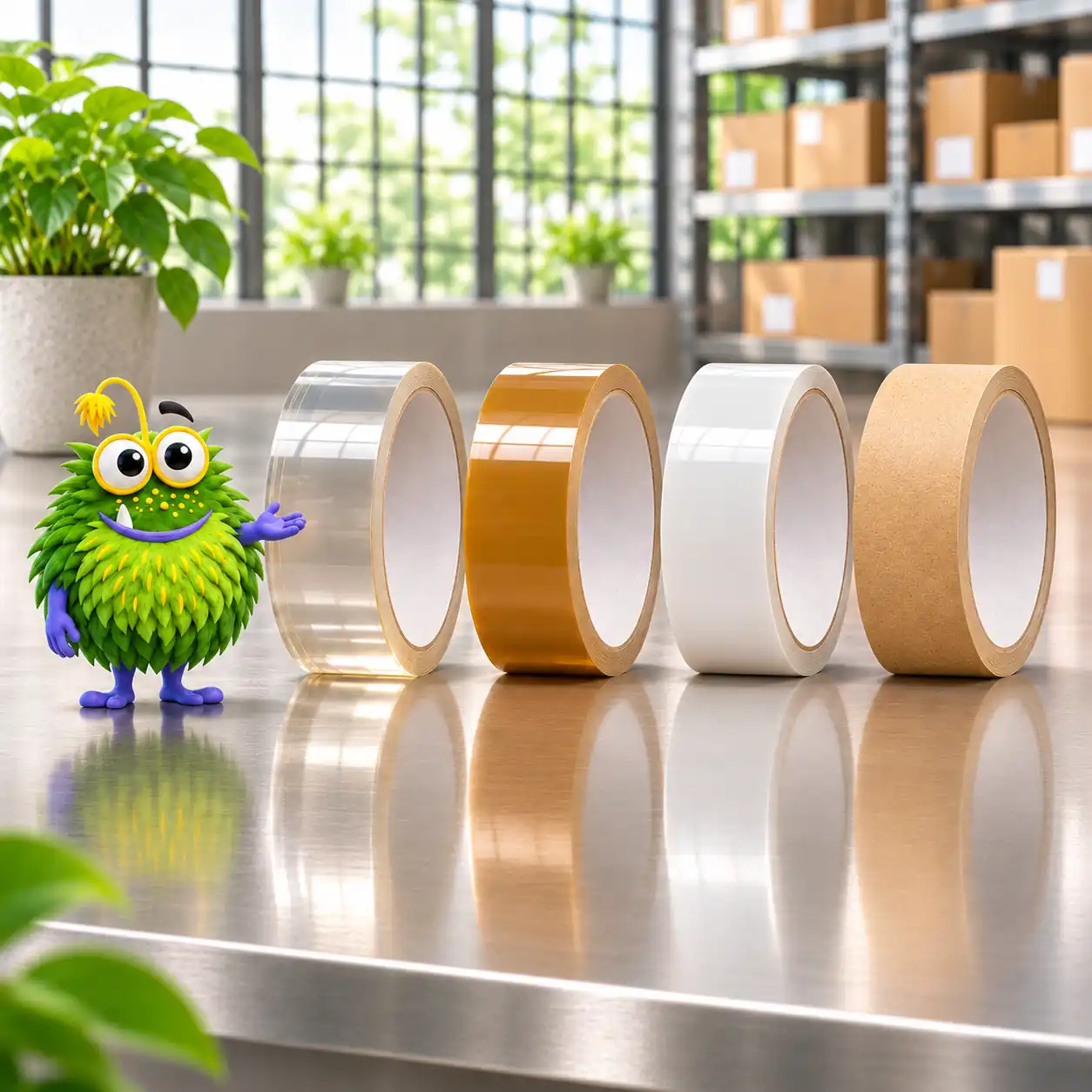
Packing tapes differ less in their film than in their adhesive. Four adhesive systems dominate the market – and each has an application in which it beats the others.
The most important figure for a head-to-head comparison is tack, the initial tackiness. In the rolling ball test, a steel ball rolls across the adhesive layer; the shorter the distance, the tackier the adhesive. Our hot melt comes in at 7 cm, the natural rubber adhesive on our PVC tape at 2 cm. In return, hot melt achieves a very high peel strength of 4.9 N/cm on steel – the ultimate adhesion once the adhesive has had time to wet out the surface. Two adhesives, two strengths: natural rubber grabs instantly, even in the cold; hot melt holds permanently on cardboard and costs less.
Acrylic adhesives play a third role: they're the least tacky at the moment of application, build up their adhesion over hours and in return are the most aging- and UV-resistant. And paper packing tape brings a fourth factor into play that no film tape can offer: it gets recycled together with the carton.
| Property | Hot melt (PP) | Acrylic (PP) | Natural rubber (PVC) | Paper (natural rubber) |
|---|---|---|---|---|
| Adhesive base | Synthetic rubber, hot melt coated | Acrylic dispersion, water-based | Natural rubber, solvent-based | Natural rubber |
| Initial adhesion (tack) | very high | medium | very high | high |
| Ultimate adhesion on cardboard | very good, after minutes | good, after 24 h | very good | good |
| Recycled cardboard, rough surfaces | very good | limited | very good | good |
| Application in the cold | from approx. +5 °C | from approx. +10 °C | even close to 0 °C | from +2 °C |
| Heat resistance (after sealing) | up to approx. 60 °C | up to approx. 80 °C | up to approx. 60–70 °C | up to +65 °C |
| UV and aging resistance | medium | very good | good | good |
| Long-term storage beyond 12 months | limited | very good | good | good |
| Unwind noise | loud (standard), quiet (Super-Melt) | quiet | quiet | quiet |
| Printability (flexo printing) | very good | good | very good | very good |
| Sustainability | solvent-free; PP film is screened out in paper recycling | water-based; PP film is screened out | solvents in manufacturing; PVC film | recyclable with the carton |
| Price level | € | €€ | €€€ | €€ |
Hot melt, natural rubber and paper values refer to the Tapemonster data sheets (Rev. 08/2026); temperature figures, except for the paper tape, are guideline values from packaging practice. We don't carry acrylic tape in our range – the column is there for a fair comparison.
Honest answer: it's a plastic tape – but among film tapes, it's the one with the slimmer footprint. What speaks for it, what speaks against it, and which rules have applied since 2026.
Hot melt is melted and coated as 100 percent solids. There are no solvents evaporating during production (no VOC emissions) and no water that has to be removed in energy-hungry drying tunnels. Nothing smells while you're packing, and according to the data sheet, the tape contains no hazardous or harmful substances.
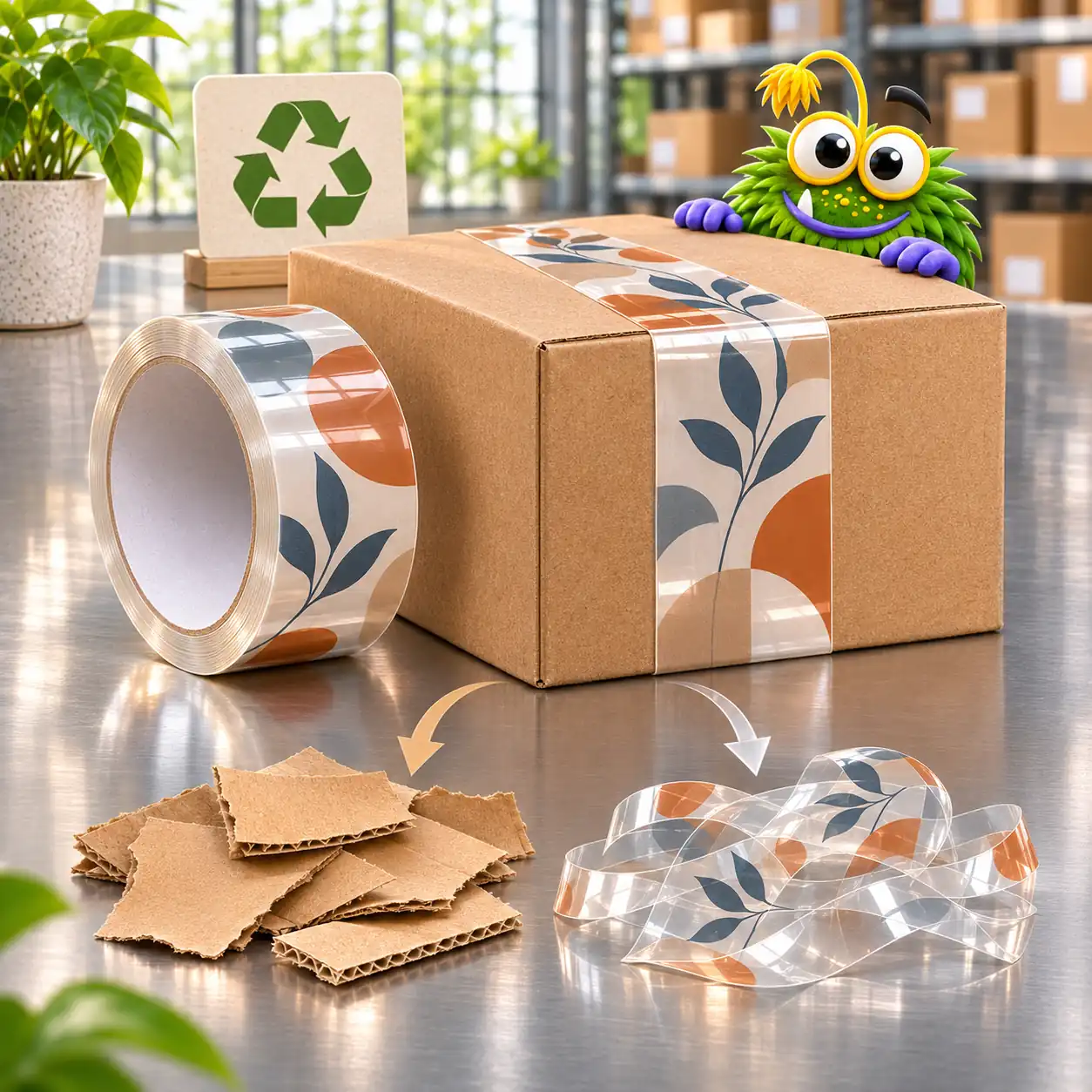
You don't have to peel packing tape off the carton before disposing of it. In the paper mill's pulper, the corrugated cardboard breaks down into fibers, while the PP film together with its adhesive is screened out as so-called rejects and usually sent to energy recovery. So the hot melt tape doesn't disrupt the recycling process – but it doesn't become new material itself, either. If you want a genuine material loop, go with paper packing tape with natural rubber, which is recycled together with the carton.
Regulation (EU) 2025/40 on packaging and packaging waste (PPWR) has applied directly in all EU member states since August 12, 2026. Packing tape counts as a packaging component under it. For you as a retailer, this means: your supplier must comply with the substance requirements – such as the combined limit of 100 mg/kg for lead, cadmium, mercury and hexavalent chromium – and ensure the traceability of every batch. From 2030, recyclability requirements will be added on top.
EU declarations of conformity under Art. 39 PPWR are available for our PP packing tapes: No. PPWR-2026-S03 for PP Hot-Melt (loud unwind) and No. PPWR-2026-S04 for PP Super Hot-Melt (quiet unwind). They cover the substance requirements of Art. 5 to 12, including REACH/SVHC, POPs and PFAS. You can download the declaration for PP Hot-Melt (PDF) directly – important for micro-enterprises shipping printed tape under their own brand.
If your packaging is supposed to be made entirely of paper, printed paper packing tape with natural rubber adhesive is the logical choice: paper backing, quiet unwind, recyclable with the carton and with a matte, premium print finish. For heavy packages, there's the reinforced version.
The smooth, corona-treated PP film is the most forgiving substrate flexo printing knows. That's why hot melt packing tape is the most-ordered material for packing tape with a logo – and the cheapest.
Printing is done by flexo printing: your design sits in relief on a flexible printing plate, the cliché, which is inked and pressed against the moving film web. The flexo printing plate is made once and kept on file for reorders – so the printing plate costs apply to the first order only. One to three ink colors are possible per design, which we match to Pantone. For the substrate you can choose white, brown or clear film – or, on request, a through-dyed custom color as the background.
Technically, printing doesn't change the adhesive properties at all: coat weight, adhesion and elongation remain those of the unprinted tape. What changes is the effect – a brown package with logo tape is perceived as a branded package before it's even opened.
Supply your logo as a vector file (PDF, AI, EPS or SVG), convert fonts to outlines and specify colors as Pantone values. Everything else is in our print file guide. Before printing, our free data check reviews every file – we only print after your approval.
The most important terms from data sheets, quotes and this guide. You'll find even more packing tape vocabulary in the Tapemonster Lexicon.
The questions that reach us most often by phone and email – answered briefly and without beating around the bush.
Hot melt refers to the adhesive, not the film: a hot melt adhesive based on synthetic rubber that is applied to the PP film in liquid form at around 150 to 180 °C and solidifies into a permanently pressure-sensitive layer as it cools. That's why hot melt packing tape bonds simply by being pressed down – without heat, water or drying time.
Hot melt packing tape bonds immediately after being pressed down and wets out rough surfaces like recycled cardboard very well; in return, it's more sensitive to heat and UV. Acrylic packing tape has less tack at application, builds up its ultimate adhesion over about 24 hours, but is more aging- and UV-resistant and tolerates temperatures up to around 80 °C. For day-to-day shipping, hot melt is the more efficient and cheaper choice; for long-term storage and outdoor applications, acrylic or natural rubber.
As guideline values: application at +10 to +40 °C (not below +5 °C), service after sealing at about −20 to +60 °C. Constant exposure above 50 to 60 °C – for example in an attic in summer or in a truck parked in the sun – softens the adhesive and weakens the bond. For such cases, we recommend PVC tape with natural rubber or acrylic tape.
Standard hot melt is meant for dry, UV-protected indoor applications. Constant sunlight, rain and large temperature swings age the rubber adhesive. For outdoor use, PVC packing tape with natural rubber is the better choice – it's more weather-resistant and UV-resistant.
The noise is created when the adhesive separates abruptly from the release layer of the layer underneath during unwinding. A thicker, stiffer film and an adapted release coating dampen this effect. Our Super-Melt packing tape uses a 28 µm film with a total thickness of 50 µm and unwinds quietly – ideal for packing stations in the office or retail store.
According to the data sheet, the tape's performance is warranted for 6 months from delivery; with proper storage, adhesive strength lasts considerably longer in practice. Store the rolls at 15 to 25 °C, below 65 % humidity, out of direct sunlight and in the original packaging, upright or lying flat on the core. Use older rolls first (FIFO) and plan your stock so that you use it up within 12 months.
The most common causes are dusty, damp or greasy carton surfaces, application below +5 °C, tape applied under too much tension (it pulls back and lifts at the ends) or rolls stored too warm. Wipe down the surface, make sure it's at room temperature, apply the tape without stretching it and press it down firmly. On very rough recycled cardboard, switching to the reinforced Super-Melt packing tape helps.
Super-Melt is our reinforced version of PP packing tape: 28 µm instead of 25 µm backing film, 50 µm instead of 45 µm total thickness and a reinforced hot melt formulation. It stands up better to heavy cartons, rough surfaces and industrial use – and it unwinds quietly.
Yes. PP packing tape with hot melt adhesive is the most-ordered material for packing tape with a logo: the corona-treated PP film is flexo-printed with one to three Pantone colors on white, brown or clear film. At Tapemonster from 36 rolls, with delivery usually 18 to 22 business days after print approval.
No. In the paper mill's pulper, the carton breaks down into fibers while the PP film together with its adhesive is screened out as rejects and sent to energy recovery. The tape doesn't disrupt paper recycling, but it isn't recycled itself, either. If you want a complete material loop, use paper packing tape with natural rubber, which is recycled together with the carton.
Our packing tapes are not intended for direct contact with food. For sealing the outer carton of a food shipment, they're not an issue as long as the tape doesn't touch the goods. According to the data sheet, the tape contains no hazardous substances and is REACH-compliant.
For each strip of tape you need the carton length plus around 10 cm of overhang. For a 400 × 300 × 200 mm shipping carton, one 66 m roll is enough for about 66 cartons with a simple seal top and bottom, about 36 cartons with an H-seal on top, or about 25 cartons with an H-seal top and bottom. A starter pack of 36 rolls therefore covers around 900 to 2,400 cartons.
Every common one: the rolls have the standard 76 mm (3") core and are 48 or 50 mm wide. Hand dispensers, tabletop dispensers and case sealers for 48/50 mm tape take them without any adjustment. A hand dispenser with a brake helps apply the tape evenly and without stretching.
36 rolls of PP packing tape with a 1-color logo print start at €139*. Data check included, print approval before production, delivery usually 18 to 22 business days after approval.
* plus VAT and shipping, incl. 1-color logo print. Sold to businesses only (Section 14 of the German Civil Code, BGB).
Temperature, storage and quantity figures without a data sheet source are guideline values from packaging practice and are marked as such. Article last technically reviewed in November 2026.
For chuckles and eye-rolls: stick around for our absurdly amusing stories – follow us on social media and we'll keep you supplied with gloriously useless stuff you definitely don't need but will surely love! Every now and then we also serve up genuinely informative news – but fun always comes first.
 PP Packing Tape
The everyday hero for e-commerce: hot melt adhesive, instant bond, inexpensive and reliable on standard cartons.
36 rolls1-color logo printData check included
Get sticking →
from€139*
 PVC Packing Tape
The pro class: brilliant print, holds rock solid even in the cold and on recycled cardboard.
36 rolls1-color logo printData check included
Get sticking →
from€189*
 Paper Packing Tape
Plastic-free and recyclable with the carton. For brands that don't just talk about sustainability.
36 rolls1-color logo printData check included
Get sticking →
from€199*
 Reinforced Paper
Tear-resistant thanks to embedded filaments: for heavy cartons, export and everything that has to arrive in one piece.
36 rolls1-color logo printData check included
Get sticking →
from€239*
* All prices plus VAT and shipping, incl. 1-color logo print. Sold to businesses only (Section 14 of the German Civil Code, BGB). Want to feel it before you stick it? Samples of all materials are available in the shop.
Mon–Fri: 8:00 am–5:00 pm
Checked by the Control Monster!
Friendly & competent
Monsters don’t make mistakes

* All prices exclusive of VAT, plus Shipping | Only real business monsters order here! Sales to businesses only (Sec. 14 German Civil Code), no consumers (Sec. 13 German Civil Code).
Prices in foreign currencies are for guidance only and based on the current exchange rate. The binding billing currency is the euro (EUR).
© 2020–2026 tapemonster – All rights reserved. Design by 
Thousands of happy customers since 2020